The most important update this week isn't in your dashboard
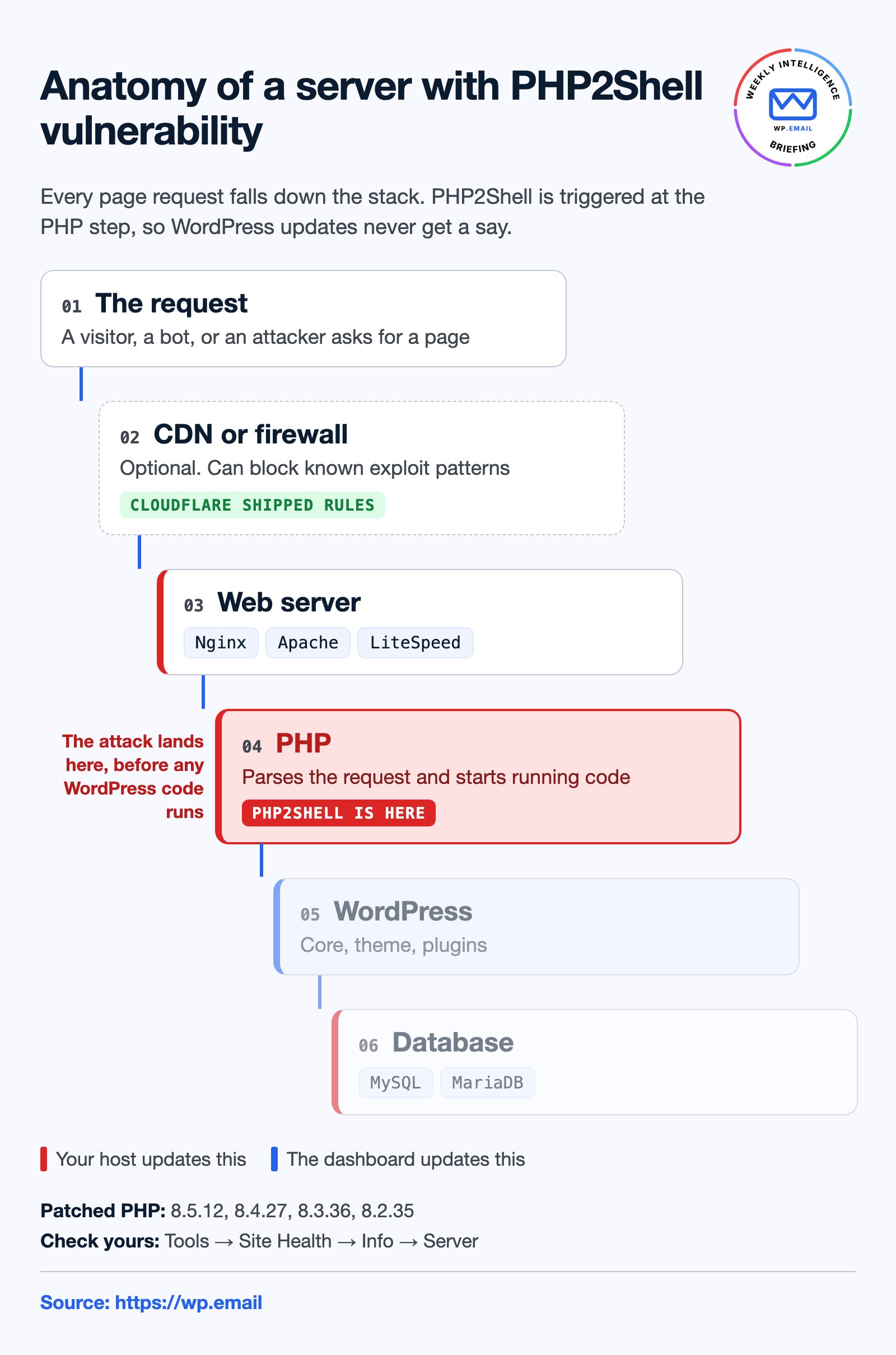
PHP2Shell lives in PHP itself, below WordPress, so no plugin or core update fixes it. Here's who owns that layer on your sites, and how to check it was patched.

By Tom Morton, Six Foot 3
Last week I said to update, but verify. This week there may be nothing to click.
On October 21 the PHP project shipped fixes for two critical flaws, CVE-2026-109618 and CVE-2026-109619, both rated 9.2. They live in the PHP interpreter, the layer under WordPress, so an attacker doesn't need a vulnerable plugin, a login, or even WordPress. Wiz says every PHP version from the last decade is affected by at least one of them, and attacks started within hours of the disclosure.
Our habits are built around the dashboard and the weekly report that says everything is green. None of it sees PHP. A site can show zero pending updates and still be running a vulnerable 8.3.
We have protocols in place to make sure all our WordPress sites are protected. We rolled out mirrors of each site, checked for PHP 8.4 compatibility (ensuring older sites that had not yet upgraded got the bump) and then pointed DNS at the new, patched servers.
So the question for this week is a boring one: who owns PHP on each of your sites? On managed WordPress hosting it's usually the host, and several of them, Kinsta and Pressable among them, told customers within a day or two that they were already protected. On a VPS, a Trellis box, or a container you built, it's you. And on PHP 8.1 or older there's no upstream point release at all, only distro backports and emergency patches, which makes this a good week to finally schedule that upgrade. Since a patch is needed anyway, bring things up to the latest version.
Either way, check the version the site actually serves. WP-Admin Site Health shows it under Tools, Info, Server, and that's the number that counts, because php -v on the command line can report a different binary than the one answering web requests. The fixed releases are 8.5.12, 8.4.27, 8.3.36 and 8.2.35.
Tom Morton
Tom runs Six Foot 3, his web consulting practice in Miami, Florida. He has been building for the web since 2008, including two years consulting for the company behind WordPress.com.
More from TomGet the WordPress Intelligence Briefing
One email a week: the week's WordPress links and a take like this one.